Thursday, May 26, 2011

The Gloves Come Off . . . Packaging vs. Nutrition


The next time you’re wandering the aisles at the supermarket spend a little time looking at labels and packaging. Then look at the label on the back (or side). If the packaging touts “reduced fat” you’ll probably find it’s higher in sugar, or high fructose corn syrup, and sodium. If it has added fiber, you’ll probably find it isn’t natural fiber. The label won’t tell you, but the list of ingredients will—and if you can’t pronounce it and if it sounds like a chemical, it probably is. Hmm . . .

Statistics tell us that two of every three Americans are overweight or obese, yet a recent Consumer Reports study found that nine out of 10 Americans think they eat healthfully. In fact 90 percent described their diet as “somewhat,” “very,” or “extremely” healthy. Hmm . . .

Are you aware of the nutritional value in the foods you choose to eat? Are you familiar with what healthy choice, 100% natural, whole grain, good source of fiber, reduced fat, fat-free, low-fat (and the list goes on) really means? Do you know soft drinks are low-fat? Hmm . . .

And, what about all those foods that promise to help your heart, lower your cholesterol, trim your waistline? These foods with health benefit claims actually have a name—functional food. Well, guess what—all of these functional foods are more about marketing than nutrition. Hmm . . .

The Nutrition Business Journal says sales of those “functional” foods alleging to fix what’s wrong with us totaled $37.3 billion in 2009, up from $28.2 billion in 2005. That’s up 32.3 percent in just four years. It looks like a lot of us are buying-in to those “healthy” packaging claims. Yet we’re spending $150 billion a year paying for health problems related to obesity. What do you think would happen to our overall health if more of us started comparing labels and ingredients against the product sales pitch on our food choices? Hmm . . .

Sunday, May 15, 2011

Are You ‘Lovin’ It? Really?


The Unites States Department of Agriculture says we spend about half our food budgets in restaurants (fast food and sit-down). That food tends to be higher in calories, sodium and saturated fat—and when we eat out, we tend to eat more . . . more cheap products full of fillers and fat.

The fast-food industry is fueled by speed and convenience. Just think of the convenience price tag alone of restaurant and fast food meals. And, if that’s not enough to lure potential customers, look at the industry’s advertising, marketing, spokespeople and slogans. We are constantly bombarded with messaging like this:

  • What you want is what you get. (McDonald’s)
  • You deserve a break today. (McDonald’s)
  • We love to see you smile. (McDonald’s)
  • Where’s the beef? (Wendy’s)
  • It’s better here. (Wendy’s)
  • Have it your way. (Burger King)
  • Your way, right away. (Burger King)
  • Best food for fast times. (Burger King)
  • We do chicken right. (KFC)
  • Finger lickin’ good. (KFC)
  • It takes two hands to hold a whopper. (Burger King)
  • Now you’re eating! (Pizza Hut)
  • Gather ‘round the good stuff. (Pizza Hut)
  • We’re lovin’ it. (McDonald’s)

Get the picture? And, these are just the words . . . the print ads and TV commercials typically show lots of smiles, a happy family enjoying a family outing. What they don’t show are numbers. A typical fast food meal, entrĂ©e, fries and beverage, can run under $5 and be served in less than five minutes. It can also average more than 1,000 calories and more than one-half the recommended daily limit of sodium, cholesterol and fat—and calories.

There’s now one fast food outlet for every 1,500 Americans and more than 1,000 of these adults and children are overweight or obese. Do you think maybe we’re “lovin’ it” just a little too much?

Friday, May 6, 2011

We Have a Drinking Problem


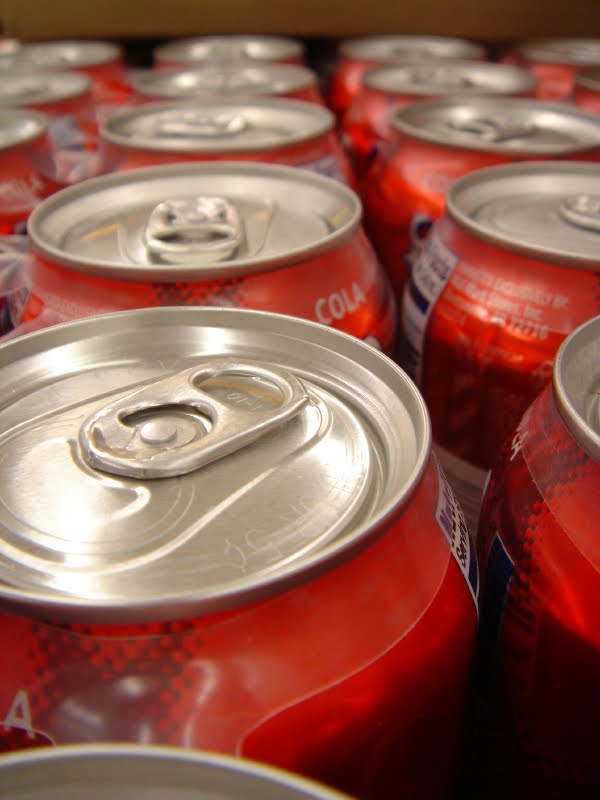
You love it, or you don’t. You drink it, or you don’t. The “it” is Coca-Cola and on May 8 it will be 125 years old. The company has evolved from one product—Coca-Cola, to more than 400 brands in 2006. It sells more than 1.3 billion drinks a day in more than 200 countries around the world.

That’s a lot of coke . . . and a lot of calories.

Soda (in all fairness, not just Coke) is the single largest contributor of calories in the U.S. diet. A 12-oz can of sweetened soda contains about 150 calories and almost 10 teaspoons of sugar. Drink just one can a day and you’ll pile on an extra 15 pounds in a single year (the average American drinks about 2 cans of soda a day). Liquid calories now account for a whopping 21 percent of our daily calorie intake—more than 400 calories every day.

Sugar sweetened drinks (including fruit drinks) have been linked to a number of contributing factors to chronic illness, including metabolic syndrome and higher blood pressure. Ten percent of overweight adults consume 450 calories of sugar sweetened beverages a day (cutting those 450 calories per day could lead to a weight loss of close to 50 pounds in one year.)

But, back to Coca-Cola. Way back when, 125 years ago, we didn’t have an obesity epidemic. Today, 34 percent of our population over the age of 20 is obese, and another 34 percent is overweight but not obese. One in three American children and teens is overweight or obese (a threefold increase over the past 30 years). And, believe it or not, this is Coca-Cola’s target market.

In the current issue of Advertising Age, Coke’s chief marketing officer notes that “teen recruitment” will be especially important to grow the business. CEO Muhtar Kent says, “we are laser-focused on targeting the right consumers, and creating new strategies that are winning over a massive new generation of teens to drive growth of Trademark Coca-Cola.”

Given our efforts to curb childhood obesity and the obesity epidemic in general, do you see a disconnect here? How exactly should we celebrate this 125th anniversary?

Monday, April 25, 2011

Happy Birthday, Everyone


Without going into why this topic comes to mind . . .

You and every other person now living, who ever has lived or ever will live, have been given a gift. No two are the same. None are perfect. Some get broken, some you abuse, some you worship, some you ignore, some you adore.

We’re talking about your body—the system of skin and tissue that holds together your bones, muscles, blood vessels, veins, organs—you get the idea. It’s the one thing each of us truly has in common. And more than 65 percent of us don’t take care of it. In fact, the most of us seem to be doing our best to destroy it.

We feed it too much, or we feed it the wrong things. We don’t ask enough of it. We don’t let it do what it was designed to do. We clog it up with chemicals, additives and just plain junk. We pay more attention to what we do and don’t put in our kitchen sinks and garbage disposals than what we put into our own bodies.

Statistics provided by the National Institutes of Health show that 67 percent of Americans age 20 and older are overweight, 34 percent are obese, and projections indicate 40 percent of the population will be obese by 2018—in just 7 years.

Now, consider that life expectancy during the 20th century increased more than 27 years, from 49.2 to 76.5 years, largely due to the reduction in mortality among children. But that was then, and this is now, and for the first time in 200 years, today’s children are looking at shorter lifespans than their parents. Why? Childhood obesity and associated chronic illnesses. The leading causes of death have shifted from infectious diseases to chronic diseases. This is our own doing.

We have developed a discouraging set of self-destructive habits. The U.S. food industry aggressively markets high-fat, high-sugar, super-sized foods. We tend to literally, eat it up. It’s fair to say it’s not all our own faults, but the question is whether our collective weight gain and sedentary behaviors are more a matter of individual responsibility, or whether a society that makes it so easy to get fat should look closely at itself and its values. At stake is the health of millions of Americans, the lives of adults and children, and more than $147 billion in annual obesity- related health care costs. And, where the blame lies is not as much the issue as what we intend to do about it.

Obviously, we can’t control every factor that influences our health and wellness. And yes, healthy people do get sick. But, there’s a lot we can control. Maybe now’s the time to think about and do those things we know make a difference—and keep those birthdays coming.